How Approved Fire Pumps Increased Output 5x Without Hiring
Learn how a second-generation fire protection company went from processing 4 jobs a day to over 20 using Ember, with no need to hire more staff.

Increasing Output 5x Without Hiring
Approved Fire Pumps is a family-run fire pump service and testing company based in Corona, California, serving customers across Southern California. In the fire protection industry, service and testing means regularly visiting commercial and industrial properties to verify that fire pumps, the mechanical systems that push water up to sprinkler systems, meet pressure and flow requirements under state-mandated inspection standards. It's detail-heavy, compliance-driven work.
The company has been in business since the early '90s, when Dena's father started it as a manufacturer's representative, brokering multimillion-dollar pump sales. When Dena Mueller took over in the early 2000s, she made a strategic shift: rather than selling pumps, she built out the service and testing side of the business. What had been 80% sales and 20% service gradually flipped entirely to service. Today, the company runs a team of four field technicians and two office staff.
The workflows, though, were still her father's. Handwritten reports. Paper work orders. Office drop-offs. It worked, but it was slow.
“Each report took an hour. If techs only came in once a week, we’d have 20 piled up. Plus customers asking where their reports were," - Dena Mueller
Eventually, the paperwork started holding them back.
The Challenge: Time-Consuming Workflows, Bottlenecks Everywhere
Every job at Approved Fire Pumps required a handwritten work order, filled out individually, by hand, for every technician, every job. Prepping those work orders alone could consume half the workday. When techs finished jobs in the field, they'd hold onto paper reports until their next office visit, sometimes a week later, arriving with a stack of 20 reports to process at once.
Then the real work started. The team relied on a pieced-together system of spreadsheets, paper, PDFs, and email with no dedicated field software of any kind. Each state-required inspection report had to be filled in manually, field by field, from handwritten notes that weren't always legible. Deciphering a tech's shorthand, calling them to clarify, and retyping everything into the correct state form took roughly two hours per report. If there were deficiencies, equipment failures or code violations flagged during testing, identifying them, writing them up, and building a repair proposal added even more time on top. Invoices couldn't go out until reports were finished, which meant payment was always delayed.
“We lost hours every day just tracking down info, rewriting reports, and figuring out what needed to go where.” - Dena Mueller
Scheduling was its own drain. Without a centralized system, building a week of routes meant manually cross-referencing job locations to avoid sending technicians zigzagging across Southern California, a process that took three to four hours. And when techs arrived on site, details like gate codes, alarm information, and site contact names often weren't on their work orders, forcing mid-job calls back to the office.
Dena had looked into field service software before. A peer recommended one platform, but the upfront cost, software, licensing, and tablets, came in around $30,000. She passed. It wasn't until Ember reached out directly that she took another look.
"I was skeptical. I thought, what is this really going to do for us? But once I started looking into it and playing around with it, I went: wow. This could save so much time and money." — Dena Mueller
The Solution: Real-Time Tools That Keep Everyone Moving
When Dena switched to Ember, the change was immediate.
Ember's field app put work orders and inspection reports directly in technicians' hands on-site. Techs now complete everything, including uploading photos, before leaving the job. The office team then reviews the submission, cleans up wording or corrects any unclear field notes, and sends the polished final report to the customer within minutes.
“What used to take hours now takes 10 minutes. It’s all right there.” - Dena Muller
Rather than manually reviewing reports and cross-referencing code requirements after the fact, Ember flags deficiencies automatically, before a report is even saved. The office sees exactly what was found, can review and track each item in one central place organized by job, and generates a repair proposal on the spot. Dena's team fills in the pricing and sends it.
“It gives you a deficiency right before you even save it. It says, 'This is a deficiency.' And it generates a quotation for you. You just put in the amounts and send it off. The paper report wasn't going to do that.” - Dena Muller
Automated pump curve generation solved a problem that had always landed on Dena personally. Flow acceptance tests for fire pumps require graphing performance curves to confirm whether a pump passes pressure and flow thresholds, work that previously required manual calculations after every test. Now, Ember generates the pump curves automatically. Dena can glance at the output and know whether a test passed in seconds.
“Before, I was the one graphing it out. The techs never knew how to do that. Now it's a responsibility I don't have to worry about because it's automatically done..” - Dena Muller
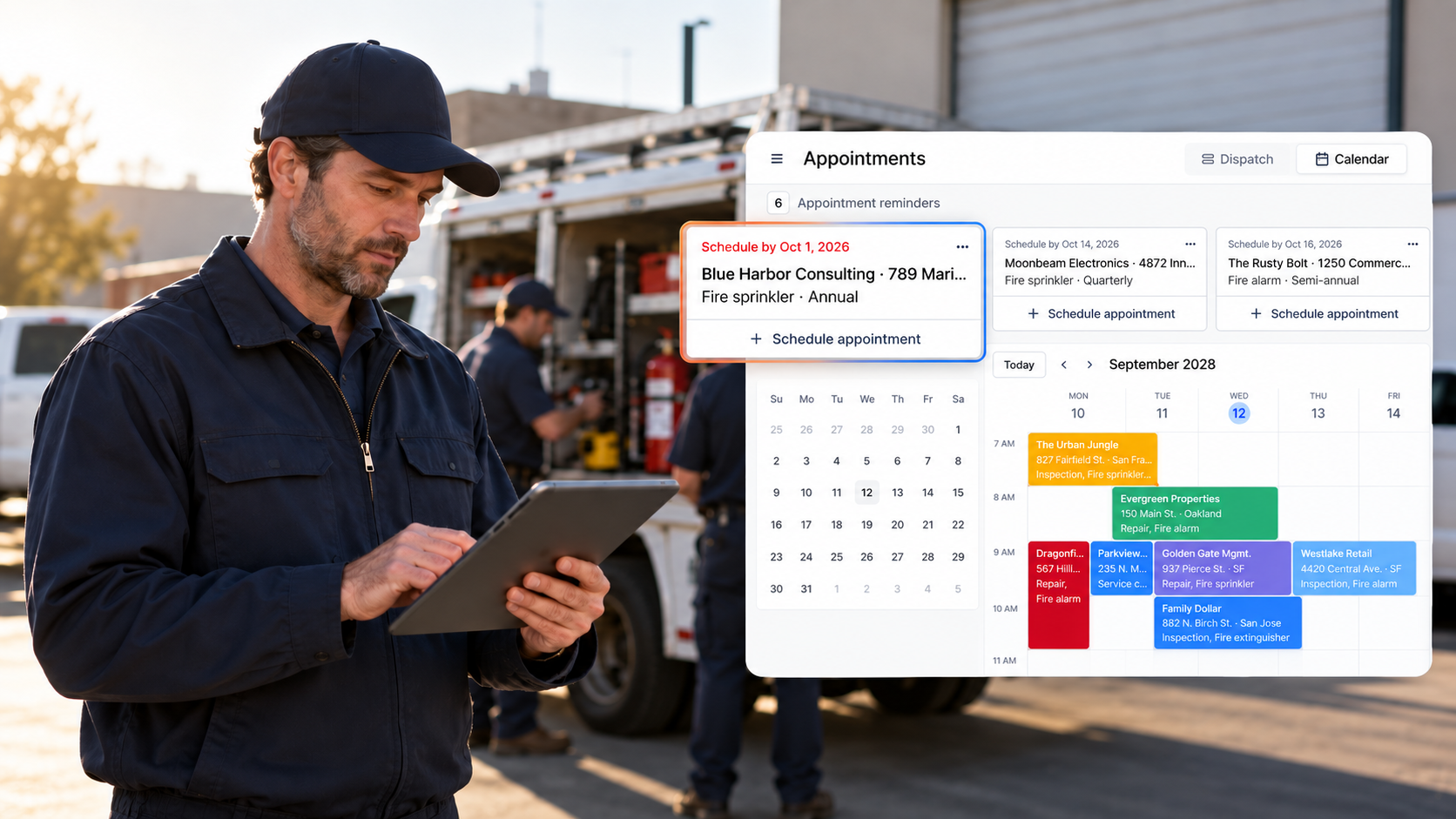
Ember's built-in scheduling tools, including a map view and calendar, let Dena plan a full week of jobs in about five minutes. Site contacts, lockbox codes, and access notes are saved from the first visit and populate automatically on future work orders, eliminating the mid-job calls from techs asking for information that should already be there.
Using a proprietary integration with The Compliance Engine by Brycer, Ember handles submissions to the Authority Having Jurisdiction (AHJ) directly.. What used to require locating the correct state form, filling it out separately, and submitting it manually is now a single click, with the right form, the right data, sent to the right people.
“It's one click. It sends it to the right people. The local jurisdiction gets exactly what they need. I've never had anyone come back with a complaint.” - Dena Muller
Remote access changed how Dena manages the business too. She no longer has to be in the office to oversee jobs. She can log in from anywhere, review completed work orders, check tech locations on the map, and manage issues on the fly.
“I was in Alaska two weeks ago and I was using the software, making sure techs were going everywhere. As an owner, that's so much more valuable because you don't have to be sitting there.” - Dena Muller
The Results: 5x More Jobs. Same Team.
Approved Fire Pumps didn't need to hire more staff. The team simply became more efficient across the board.
- Office processing time per job dropped from 2+ hours to 15–30 minutes, driven by Ember's deficiency tracking, proposal building, AHJ submissions via The Compliance Engine by Brycer, and same-day invoicing
- Reports and invoices go out the same day instead of days later, made possible by techs completing work orders on-site and the office reviewing and sending in minutes
- Scheduling a full week takes 5 minutes instead of 3–4 hours, thanks to Ember's map view and calendar
- Deficiencies are flagged automatically at report completion, with repair proposals generated on the spot, replacing a multi-step manual process
- Automated pump curve generation eliminated manual graphing after every flow acceptance test
- AHJ submissions via The Compliance Engine by Brycer take one click instead of a multi-form manual process
- 4+ hours saved per day across the team
- The team now completes 20+ jobs per day, up from 4 to 5
"We used to be able to process 4 jobs a day. Now we can do 20. Ember helps us move five times faster without needing to grow the team." - Dena Mueller
A Modern Workflow That Just Works
With Ember, Dena and her team can work from anywhere. Field techs have full visibility into their schedules for the full week. Office staff can review and clean up field reports before they reach customers. Deficiencies are flagged automatically. Proposals are generated instantly. AHJ submissions are one click.
“It makes us look more professional, saves hours every day, and gives me back time to run the business. Even our least tech-savvy guy loves it.”
The onboarding experience stood out too. Ember sent someone on-site to walk every technician through the platform in person, and the support didn't stop there.
“Best I’ve ever had. Fast replies, step-by-step help, and they don’t disappear after onboarding. They’re in your corner.”
“I Don’t Care What It Costs. Do It.”
“If someone’s thinking about switching to Ember, I tell them: I don’t care what it costs. Do it. It’ll change your work life. You’ll go home earlier, get more done, and finally get out of the paperwork mess.”
News & Resources

Ready to simplify your fire inspection workflow?
Get a Free Demo