Fire Extinguisher Inspection Checklist
Wondering what fire inspection companies need to inspect to comply with fire extinguisher inspection regulations? Check out our guide today!

Key Takeaways
- Fire extinguisher inspections are governed by overlapping requirements from NFPA 10, OSHA 29 CFR 1910.157, local AHJs, and, in many cases, state licensing rules, so fire protection companies need to understand how each one affects compliance and documentation.
- NFPA 10 breaks extinguisher service into monthly visual checks, annual maintenance, 6-year internal maintenance, and hydrostatic testing, with different scopes, intervals, and recordkeeping requirements for each.
- A strong fire extinguisher inspection checklist should match the specific service interval and include clear documentation of condition, pressure, mechanical components, maintenance actions, and test results.
- The deficiencies companies encounter most often include missing or expired service tags, out-of-range pressure gauges, broken tamper seals, blocked extinguishers, and compacted dry chemical agent.
- Consistent documentation and field-ready software can help companies keep inspections accurate, support AHJ submissions, and reduce the risk of missed requirements across client sites.
Fire extinguisher issues frequently appear among the deficiencies cited in commercial inspections. When they surface during an AHJ review, the questions land on your fire protection company as much as your client. Whether it's a missed hydrostatic interval, a deficiency that wasn't documented, or a checklist that didn't meet the local AHJ's requirements, the professional and legal exposure runs both ways.
To ensure your team is fully prepared for fire extinguisher inspections, review our guide to the regulatory frameworks governing these inspections and the professional checklists your team should be following.
Regulatory Framework: NFPA 10, OSHA 29, and the AHJ
Most commercial clients are subject to NFPA 10, OSHA 29, and the AHJ simultaneously. Understanding what each of these frameworks governs helps your fire protection company identify where compliance gaps exist and whose enforcement authority is in play.
- NFPA 10 fire extinguisher inspection requirements: NFPA 10 is the technical standard governing how portable fire extinguishers are inspected, maintained, and tested. Because most state and local fire codes adopt NFPA 10 by reference, it governs the actual procedures your technicians follow in nearly every jurisdiction. This is the standard your checklists, service intervals, and documentation practices are built around.
- AHJ fire extinguisher requirements: AHJ requirements are set by the Authority Having Jurisdiction (typically a local fire marshal or fire prevention bureau), who enforces the adopted fire code and can layer requirements on top of NFPA 10 minimums. The AHJ is the entity that inspects buildings, issues citations to property owners, and determines what “compliant” means locally. Before servicing a new territory or occupancy type, verify AHJ requirements directly, since what passes in one jurisdiction may not pass in the next.
- OSHA 29 CFR 1910.157: OSHA 29 CFR 1910.157 applies specifically to employers, meaning it governs your clients’ obligations for fire extinguishers in their workplaces. It’s enforced by federal OSHA rather than the local fire official, running on a parallel track from the AHJ. A facility can pass an AHJ inspection and still receive an OSHA citation if annual maintenance records aren’t properly retained, for example. As the inspection company, you’re not the one being cited, but your documentation practices directly affect whether your clients are protected on both fronts.
- State requirements: State-level licensing is a separate consideration that governs your fire protection company’s authority to perform the work at all. Several states require technicians to hold a state-specific license or certificate of registration before performing inspections or maintenance. Holding a national credential like ICC/NAFED certification may not satisfy a state’s registration requirement on its own. Verify in every state your business operates.
- Insurance requirements: Many commercial carriers require documentation of compliant fire extinguisher service as a condition of coverage. Some will deny claims after a fire incident if inspection records are incomplete or the service history shows gaps.
NFPA 10 Inspection and Maintenance Intervals
NFPA 10 structures fire extinguisher service into four distinct intervals, each with its own scope, required competency level, and documentation obligations. Fire inspection businesses need to be fluent in all four because the 6-year and hydrostatic intervals are where client sites most often fall out of compliance without realizing it.
Find out more about the four main inspection and maintenance intervals that any fire inspection business should stay on top of:
- Monthly visual checks: Trained facility staff should perform a monthly visual check approximately every 30 days to confirm location, pressure, and general condition.
- Annual maintenance: Yearly maintenance must be performed by a qualified technician. The fire extinguisher annual maintenance checklist requires a full mechanical exam, new tamper seal, updated tags, and records retained for at least one year.
- 6-year internal maintenance: 6-year internal maintenance requirements apply to stored-pressure units requiring a 12-year hydrostatic test (typically dry chemical). Units must be emptied, internally examined, and fitted with a verification-of-service collar.
- Hydrostatic testing: Hydrostatic testing intervals vary by type. For example, dry chemical needs a test every 12 years, while wet chemical, water, and CO2 need one every 5 years. Non-rechargeable extinguishers are removed from service at 12 years from manufacture.
Professional Fire Extinguisher Inspection Checklists
The following checklists reflect NFPA 10 requirements for each service interval:
Monthly Visual Inspection
- Unit is in its designated location, mounted at the proper height, and unobstructed
- Nameplate instructions are legible and facing outward
- The safety pin is in place, and the tamper seal is intact
- Pressure gauge reads in the operable (green) range
- No visible damage, corrosion, leakage, or clogged nozzle
- Unit has sufficient weight (lift to confirm it hasn’t been partially discharged)
- Tag is initialed and dated for the current month
Annual Maintenance
- Complete all monthly inspection items
- Verify extinguisher type and model against the manufacturer’s service manual
- Examine all mechanical parts, such as the handle, lever, valve, and discharge tube, for condition and function
- Remove the pull pin and the old tamper seal. Verify that the operating mechanism functions correctly
- Inspect the hose, nozzle, and valve for wear or blockage; clear or replace as needed
- Verify agent charge against the nameplate spec. If below the acceptable level, recharge it.
- For dry chemical units: invert and agitate to confirm the agent isn’t compacted
- Install a new tamper seal; attach an updated tag with date, technician ID, and company name
- Document the service in the unit’s maintenance record
6-Year Internal Maintenance (Stored-Pressure Dry Chemical)
- Complete all annual maintenance steps
- Depressurize, disassemble, and recover the agent per applicable regulations
- Inspect the cylinder interior for corrosion, pitting, or contamination; reject if significantly deteriorated
- Replace valve components, o-rings, and gaskets as needed; refill and repressurize to spec
- Install a verification-of-service collar around the valve neck; mark with month, year, and company name
- Update the service tag and maintenance record
Hydrostatic Testing
- Remove the unit from service; tag the mount and confirm a replacement is in place
- Perform a full external visual exam; reject the shell if corrosion, dents, or heat damage are present
- Depressurize, disassemble, and conduct the hydrostatic pressure test
- Reject any cylinder that shows distortion, leakage, or fails to return to original dimensions
- Dry completely, refill, recharge to spec, and mark with the test date, pressure, and company name
- Document all test results in a record retained until the next test or permanent shell removal
Common Deficiencies Fire Protection Companies Find in the Field
The same deficiencies appear often enough that experienced technicians can anticipate them before arriving on site. The most common deficiencies include:
- Service tag issues: Expired or missing service tags are the most frequently cited failure. The annual deadline passes, no one tracks it, and the tag is the only visible evidence that something is overdue.
- Out-of-range pressure gauges: Pressure gauges that are out of operable range are common on units that were partially discharged without a follow-up service call. A gauge in the red means the unit comes out of service immediately.
- Tamper seals: Missing or broken tamper seals may indicate prior use that was never reported. Per NFPA 10, a missing seal on a rechargeable extinguisher triggers a full maintenance requirement, not just a tag replacement.
- Accessibility: Blocked or inaccessible units are persistent in warehouses and commercial kitchens where inventory migrates in front of wall mounts between inspection visits.
- Compacted extinguisher agents: Compacted dry chemical agent goes undetected on sites where no one has been inverting units. Caked powder can prevent discharge entirely, even on a unit that reads full on the gauge.
- Missing extinguishers: Missing fire extinguishers in areas where they’re required.
When any deficiency is found, tag the unit out of service, confirm a replacement is in place, and document the finding before leaving the site.
Keep Every Inspection Job-Ready and AHJ-Ready with Ember
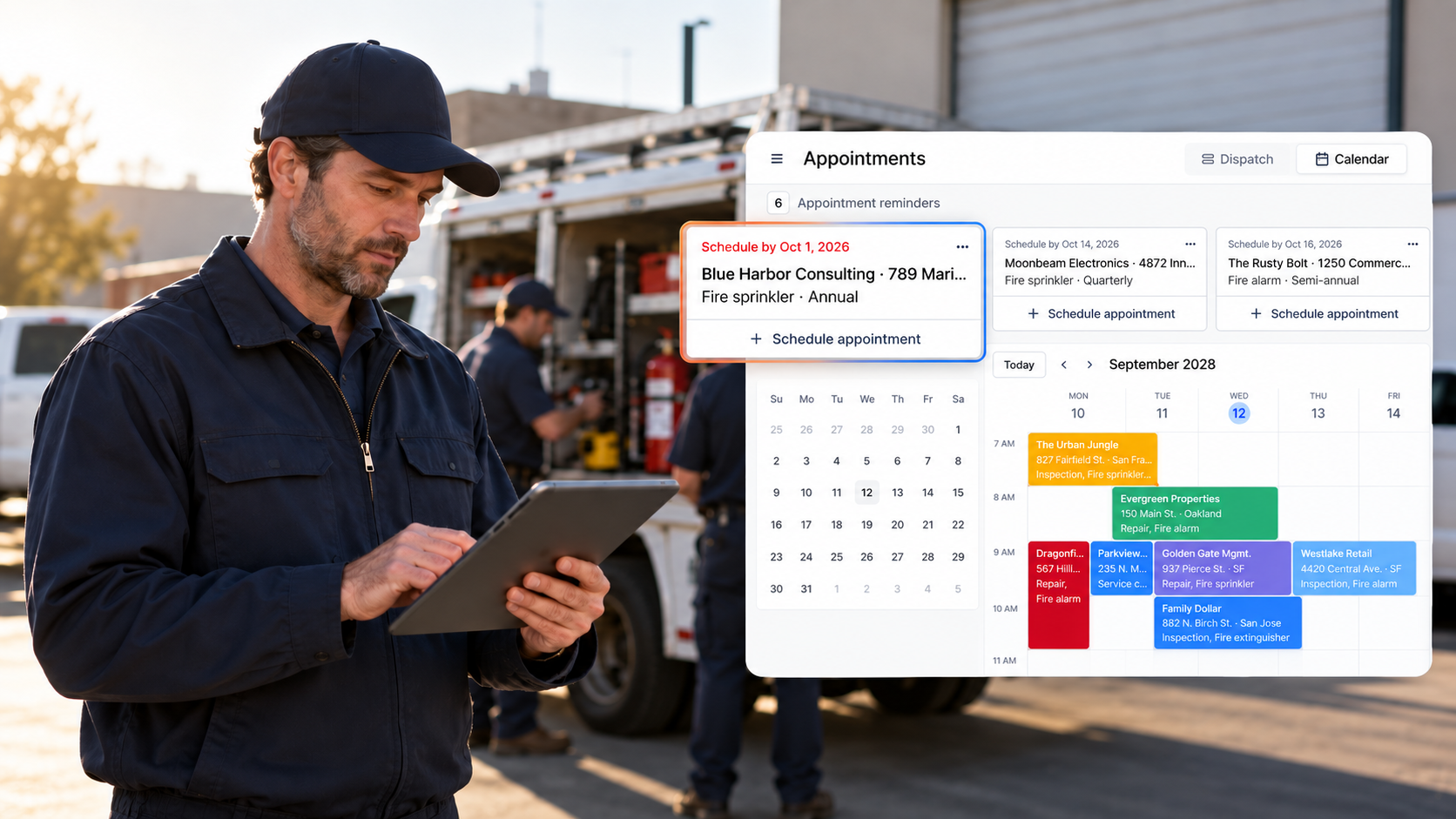
Ember is fire inspection software built for companies like yours. Digital inspection forms keep your technicians moving through jobs faster in the field, while asset lists give you a complete service history for every extinguisher across your entire customer base.
As more and more AHJs require the submission of fire extinguisher reports, Ember’s one-click AHJ submission tool ensures your team complies with requirements, letting you send accurate inspection reports directly to the AHJ without the manual back-and-forth.
Learn more about our fire inspection software today. If you’d like to see how Ember can support your team and ensure your inspections stay on track, please book a demo!
News & Resources

Ready to simplify your fire inspection workflow?
Get a Free Demo