Fire Inspection Reporting: NFPA Requirements and Best Practices
AHJ Fire Inspection Report: What Gets Submissions Rejected
Fire Inspection Reporting: NFPA Requirements and Best Practices
Key Takeaways
- AHJ rejections are rarely caused by a failed inspection and more often stem from incomplete or inconsistent documentation in the report that follows it.
- NFPA 25 and NFPA 72 require test results to be documented at the device or component level, and a system-level summary does not meet that standard, regardless of how thorough the inspection was.
- NFPA defines exactly three deficiency categories: Non-Critical, Critical, and Impairment. Inconsistent classification across your team creates a paper trail that won't hold up if a deficiency is ever challenged.
- Your retained ITM records are your legal defense: a complete chain of component-level results, accurate deficiency classification, and corrective action documentation prove the work was done correctly if system performance is ever questioned.
- Documentation inconsistencies that are manageable at low volume become a pattern that draws AHJ scrutiny, delays approvals, and holds up billing when you are running 20-plus inspections a week across multiple technicians.
A completed inspection and an accepted AHJ submission are not the same thing. For experienced fire protection contractors, the gap between the two rarely comes from not knowing the requirements. Rather, it comes from managing the documentation chain that follows the inspection. Report assembly, deficiency classification, AHJ submission, and record retention all have to hold up under scrutiny.
Across a multi-tech team running inspections at volume, this chain breaks down in small, repeatable ways. Most contractors know the NFPA requirements cold. Executing them consistently, week after week, is where the real work is.
ITM Report Requirements: What Makes Documentation Defensible
Knowing what NFPA requires and producing reports that consistently meet those requirements across every tech, every job, every week are two different things. The difference between a report that passes AHJ review and one that gets flagged usually comes down to a small number of specific fields, and the failure isn't always visible until a submission is rejected.
To put your submission in the best position to succeed, learn more about the specific inspection, testing, and maintenance (ITM) requirements that determine whether a report holds up under AHJ scrutiny:
1. Technician Attribution and System Identification
Every ITM report needs to identify the performing technician by name, credential, and license number, and tie that attribution to the specific system they inspected. AHJs use attribution to verify that a qualified individual completed the work, and missing or ambiguous attribution reliably triggers rejection.
Beyond the submission, incomplete attribution creates liability exposure. If a system's performance is ever called into question after a fire event, your documentation needs to show exactly who performed the work and what they were certified to do.
2. Component-Level Results Under NFPA 25 and NFPA 72
Both NFPA 25 and NFPA 72 inspection reporting require test results documented at the device or component level. A report stating "fire alarm system tested — operational" does not meet that standard.
Under NFPA 72, each initiating device and notification appliance needs an individually recorded outcome, such as “smoke detector at location 1A-03, tested, passed; horn/strobe at location 2B-11, tested, passed.”
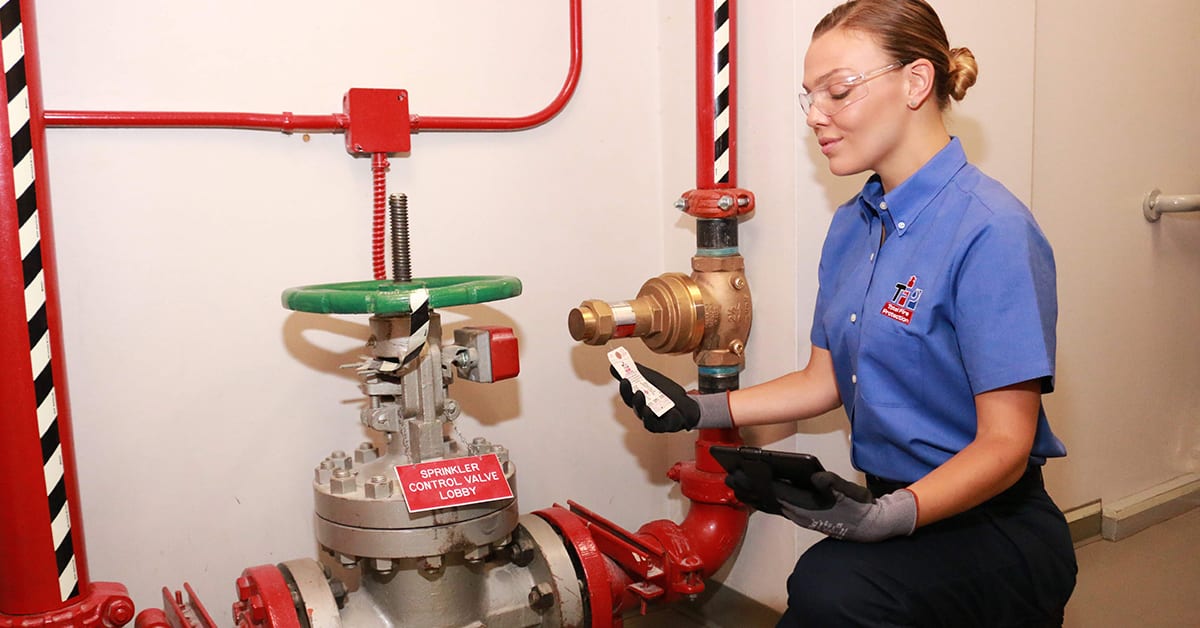
The same logic applies to water-based systems. NFPA 25 requires component-level results across control valves, gauges, and alarm devices.
System-level summaries are faster to write, especially at volume, but they are among the most consistent reasons fire inspection reporting falls short of what AHJs require to accept a submission.
3. NFPA Deficiency Classification and Corrective Action Documentation
NFPA defines exactly three deficiency categories: Non-Critical, Critical, and Impairment. The definitions are clear, and applying them consistently requires judgment.
When techs classify the same condition differently job to job, that is a documentation discipline problem, not a standards interpretation problem. Inconsistent classification produces a paper trail that won't hold up if a deficiency is ever challenged.
Whether fire inspection deficiency documentation gets included on the original inspection report or tracked in a follow-up depends entirely on whether it qualifies as an Impairment. Conflating the categories sends work down the wrong documentation path.
Every defensible deficiency record needs five elements:
- What was found: A specific description of the condition, not a checkbox.
- Which asset: System type and component identifier.
- Severity classification: Non-Critical, Critical, or Impairment per the applicable NFPA standard.
- Technician attribution: Who identified it, with credential information.
- Corrective action status: Documented at the time of the report, not filled in after the fact.
4. Fire Inspection Record Retention Requirements
Retention requirements vary based on which code your jurisdiction has adopted, but there are three reference points every contractor should know:
- NFPA 25: Records must be kept for one year after the next occurrence of that inspection type, meaning your most recent report stays on file until the following inspection cycle is complete.
- IFC jurisdictions: The International Fire Code sets a three-year minimum, with records kept either on-premises or at an approved location.
- Local amendments: Requirements can go beyond what either standard sets, so verify with your AHJ before establishing any destruction schedule.
If system performance is ever questioned after a fire event, a complete chain of ITM records showing component-level results, accurate deficiency classification, and follow-through on corrective actions establishes that the work was done and done correctly.
Where Fire Inspection Reporting Breaks Down at Volume
Inconsistent documentation is easier to manage when one technician is doing all the work. The problem shows up when you're running 20+ inspections a week across multiple technicians with no standardized way to ensure the same fields are completed consistently. At that volume, operations tend to break down at four points:
- Inconsistent attribution across techs: One tech includes a license number and a credential, another doesn't. The report passes your internal review without issue, but is flagged by the AHJ for incomplete attribution.
- Deficiency records lost in the handoff: Found in a field note or on a paper form, then incompletely transferred into the final report before it goes out.
- No post-submission visibility: An AHJ fire inspection report sits in a separate portal for days before anyone on your team knows it was flagged for missing information.
- Compounding errors: One missed field at low volume is a quick correction. However, across 20-plus inspections a week, it becomes a documentation pattern that draws AHJ scrutiny, delays approvals, and holds up billing.
How a Connected Documentation Chain Closes the Gap
The problems above aren't solved by retraining techs or building a better checklist. Connecting the documentation chain so the right information gets captured in the field, stays linked to the right asset, and reaches the AHJ without manual assembly is what closes the gap.
Find out how purpose-built fire inspection forms and software address each breakdown directly:
- Pre-filled forms: Purpose-built fire inspection software loads customer details, asset records, and prior inspection data into the form before the tech arrives on site. This approach reduces the input variation that leads to component-level documentation gaps.
- Required fields: Field-level validation prevents techs from completing and submitting an inspection with missing attribution or incomplete device results, so the specific fields that trigger AHJ rejections get captured before the job closes.
- Deficiency classification in the field: Software built for fire inspection workflows records severity, asset ID, and technician attribution at the time of the inspection and keeps them linked to the correct location throughout the report and submission process.
- One-click AHJ submission with real-time status tracking: Direct integrations with Brycer TCE, IROL, and LivSafe mean no separate portal logins. With real-time status tracking included in the software, your office can see whether a submission is pending, accepted, or flagged without leaving the platform.
Fix Your Fire Inspection Reporting Processes with Ember
Ember is fire inspection software built to eliminate the documentation gaps that get reports rejected. Pre-filled forms, required fields, in-field deficiency classification, and direct AHJ submission integrations are all built into a single platform. These features make it easy for fire inspection teams to produce consistent, defensible reports at any volume.
Learn more about our digital fire inspection forms today. Schedule a free demo to see how it works.
News & Resources

Ready to simplify your fire inspection workflow?
Get a Free Demo