How to Grow a Fire Inspection Business
See how fire inspection software increases capacity, speeds up proposals, and drives growth.
Key Takeaways
- You can meaningfully grow your fire protection business by going paperless, choosing specializations or expansion deliberately, increasing capacity, speeding up proposals, and tracking the right growth metrics.
- Paper forms create the delays that slow every other part of the business down, from proposals to reporting to AHJ turnaround.
- Adding more service lines isn't always the fastest path to growth, and going deeper as a specialist can outperform expanding broader.
- Approved Fire Pumps and Bay Cities Fire Suppression both saw major gains after switching to Ember, from processing five times more jobs to cutting inspection time nearly in half.
- Renewal rate, repeat revenue, revenue per customer, and cost per lead reveal whether a fire protection company is actually growing.
Your techs are certified, your Google Business Profile has solid reviews, and referrals keep trickling in from the electricians and property managers you've worked with for years. You've done everything the growth checklists tell you to do to grow your fire business. Despite this work, your business still feels stuck at the size it was two years ago, and that's rarely a marketing problem.
More often, it comes to a capacity and speed problem, which refers to how much your team can get done in a day and how fast a deficiency turns into a signed proposal. To fix this problem, review the five moves below, which cover moving off paper, deciding whether to specialize or expand, adding capacity without new hires, speeding up proposals, and tracking the numbers that actually show growth
5 Ways to Grow a Fire Inspection Business
Fire protection companies grow by increasing job capacity, converting deficiencies into proposals faster, and tracking the metrics that prove repeat business is working.
These three factors build on the fundamentals you already have in place. They don't replace certifications, reviews, or referrals, but they do separate companies that plateau from companies that keep adding jobs to the schedule year after year. If you want to put your business in the best capacity to separate itself from the competition, review the following top five tips for growing a fire inspection business:
1. Move Your Team off Paper Forms
Paper forms are where speed dies. A handwritten inspection sheet has to get transcribed before anyone in the office can act on it, and anything illegible, incomplete, or left in a truck overnight becomes a delay somebody has to chase down later.
Ember's digital fire inspection forms prefill with customer, asset, and prior inspection data before a tech ever arrives on-site, and required fields make sure nothing leaves the job half-documented. Once a tech closes out an inspection, that same data flows directly into reports, proposals, and AHJ submissions without anyone retyping a line of it.
This shift to digital inspection forms is what makes almost everything else on this list possible. Faster proposals, more accurate metrics, and more jobs per week all depend on accurate field data reaching the office the moment it's captured.
2. Decide Whether to Specialize or Expand Services
Plenty of growth advice tells you to add service lines over time, starting with extinguishers and expanding into alarms, sprinklers, and kitchen suppression. This path works for some companies, but for many contractors it isn't the right move.
Property managers and facility directors increasingly want a specialist they trust for one system. A fire extinguisher business known for showing up on time and passing every AHJ review can out-compete a broader competitor who spreads attention thin.
Instead of asking whether you add another line of business, ask whether you're already the fastest, most reliable option for the customers you have. If deficiencies sit for days before a proposal goes out, or if AHJ resubmissions are a regular headache, that's a sign to fix your current service before adding another one. If your team has capacity to spare and customers are already asking about alarms or sprinklers, expansion may be the better bet.
3. Increase Job Capacity Without Adding Headcount
Adding technicians is the default answer to "we need to grow," but it's the most expensive one, and it doesn't scale in a straight line. Every new hire needs a truck, tools, training, and months before running solo jobs at full speed. The more available lever is capacity, meaning getting more done with the team already on payroll.
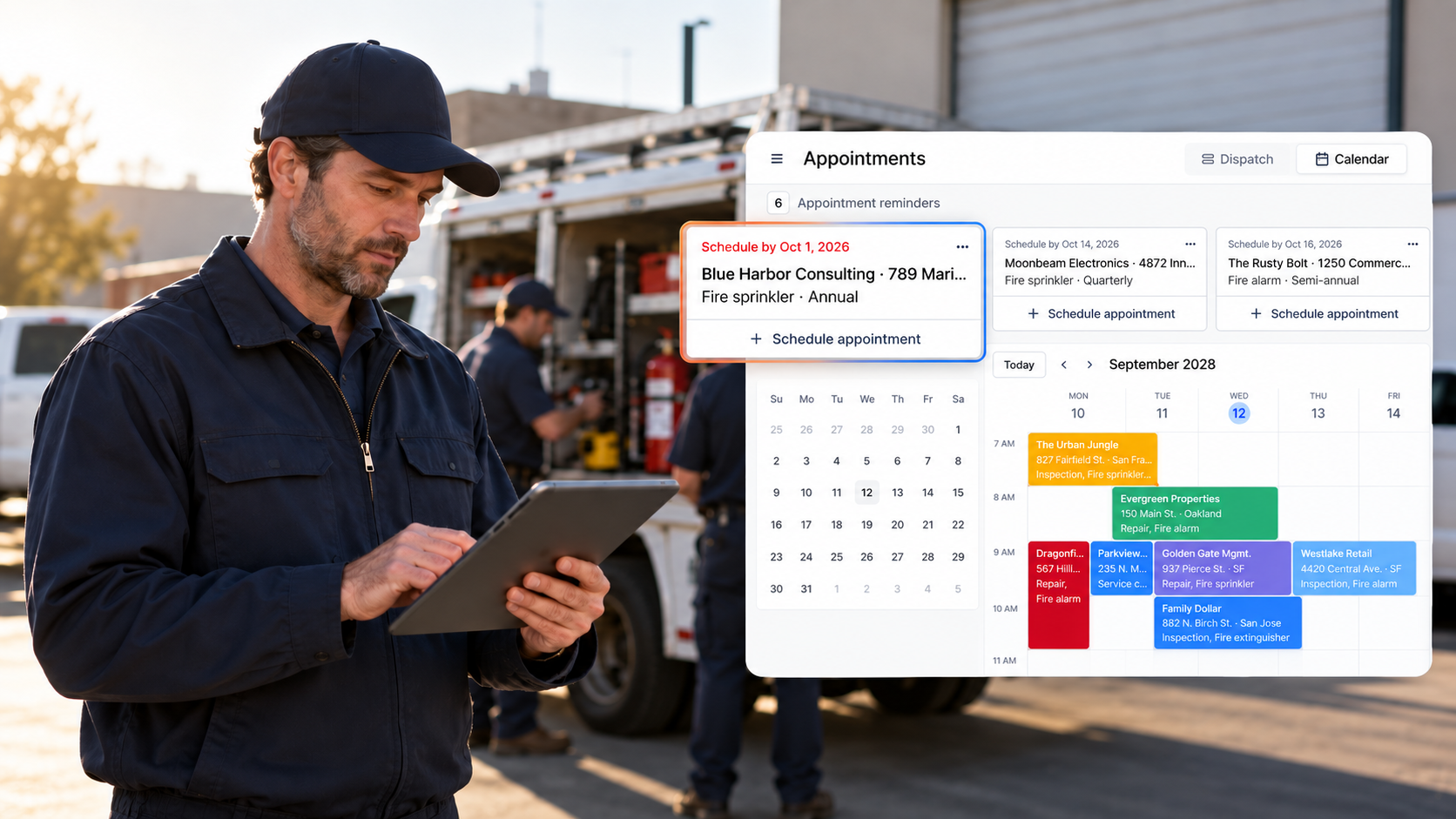
The real gains in capacity come from cutting the non-billable time between finishing one job and starting the next, and software is what closes that gap. Scheduling software that centralizes contacts, gate codes, and access notes means techs stop losing time on calls to the office mid-job. Digital forms that carry over prior inspection data mean reports don't have to be rewritten or double-checked after the fact. Fire inspection software that automates calculations, like pump curve results, cuts time that used to go into manual work.
Approved Fire Pumps cut that non-billable time between jobs by switching to Ember's fire protection software. After switching to Ember, contacts and access notes were already attached to every job, scheduling a full week took about five minutes instead of hours, and pump curves generated automatically instead of by hand. None of it required a new hire. The team went from four jobs a day to twenty with the same headcount.
4. Turn Deficiencies Into Proposals Faster
A deficiency your tech finds during an inspection is either a line on a checklist or a proposal waiting to be sent, and the difference is speed. Send a customer a clear, professional proposal the same day they learn about a problem, and they're already primed to say yes. A callback that takes a week to arrive lets that same urgency fade before the office ever gets the customer on the phone.
Speed comes from cutting the steps between a tech spotting a problem and a customer seeing a proposal. Ember's fire inspection proposals pull deficiency details, photos, and notes directly from the completed inspection into a branded proposal, so the office isn't rebuilding it from scratch. Once approved, the job flows straight into scheduling and AHJ submissions without anyone re-keying a line.
Bay Cities Fire Suppression improved efficiency by adopting Ember's fire inspection software. Digital forms let the team complete inspections on-site in real time, and AHJ submissions that once required scanning and follow-up calls started going out with a single click. Inspections that used to take two to three hours dropped to as little as one to one and three-quarter hours. Even better, the team went from spending two to three days a week catching up on paperwork to just one or two days a month.
5. Track the Metrics That Reveal Real Growth
Certifications, reviews, and referrals matter, but none of them tell you whether the business is actually growing. The following four metrics do:
- Renewal rate: The percentage of customers who book their next required inspection with you instead of shopping around. Since inspections are required by law on a set schedule, a dropping renewal rate is often the first sign of a service problem, well before a customer says anything directly.
- Repeat revenue: How much of this year's revenue came from existing accounts versus net-new customers. A fire protection company built on repeat business should see this number climb steadily as customers stay on the books, rather than staying flat because new accounts are constantly replacing lost ones.
- Revenue per customer: What each account is worth once proposals for repairs and upgrades are factored in, beyond the base inspection fee. Growth here usually means your team is catching and pricing deficiencies consistently.
- Cost per lead: What you're actually spending to land each new customer, across referrals, local search, and any paid channels. Without this number, it's hard to tell if new business is profitable or just expensive to acquire.
Grow Capacity Without Growing Your Overhead with Ember
Growing a fire protection company comes down to getting accurate information out of the field and into the hands of whoever needs to act on it, whether that's your office building a proposal or the AHJ reviewing a submission. For any fire inspection company running this workflow, Ember connects that entire chain, from the inspection your tech completes on-site to the report that reaches the AHJ, so nothing gets rebuilt, re-typed, or lost along the way.
See how Ember's digital fire inspection forms turn field data into proposals and reports without anyone re-entering a line. Schedule a free demo to see the full workflow in action for your team.
News & Resources

Ready to simplify your fire inspection workflow?
Get a Free Demo