NFPA 25 Inspection Requirements: What Fire Protection Companies Need to Know
Trying to keep up with NFPA 25? Here's what it actually requires, from inspection frequencies to why your older systems still aren't grandfathered in.

NFPA 25 Inspection Requirements: What Fire Protection Companies Need to Know
Key Takeaways
- NFPA 25 has no retroactivity clause, so even decades-old fire protection systems must meet the currently adopted edition.
- The standard sets seven inspection and testing frequency tiers, ranging from weekly checks to component testing every ten years or more.
- The property owner holds ultimate responsibility for NFPA 25 compliance, even when a contractor performs the work, and an AHJ enforces it.
- NFPA 25 isn't law by itself, but it becomes enforceable once a jurisdiction adopts it through a building or fire code.
- The 2026 edition of NFPA 25 is now the most current published version, though most AHJs still enforce the 2020 or 2023 edition.
Staying on top of NFPA 25 means tracking a long list of small requirements, and it's easy to assume you've got the basics handled until one catches you off guard.
Take an old fire sprinkler system installed thirty years ago. Plenty of owners assume it only has to meet the code in place when it was installed, but NFPA 25 doesn't include a retroactivity clause, so whatever edition your AHJ has adopted is what everyone is held to today. It's one example of how granular NFPA 25 gets.
The rest of this post covers which systems fall under the standard, how often each one needs attention, who carries the compliance obligation, and what happens when a deficiency goes uncorrected. Missing any one of those pieces is usually what turns a routine inspection into a bigger problem than it needed to be.
What Is NFPA 25?
NFPA 25 is a national standard that sets minimum requirements for inspecting, testing, and maintaining water-based fire protection systems after installation.
Published by the National Fire Protection Association and updated on a three-year cycle since 1992, NFPA 25 exists because systems that pass acceptance testing can quietly stop working over the years. A corroded pipe or a painted-over sprinkler head can sit undetected until the system needs to perform, which is exactly what regular inspection, testing, and maintenance (ITM) catches early.
What Does NFPA 25 Cover?
NFPA 25 covers every major water-based fire protection system type once it's installed and in service, with each one addressed separately within the standard.
The standard's chapters address several system types:
- Sprinkler systems, including wet pipe, dry pipe, preaction, and deluge configurations
- Standpipe and hose systems
- Fire pumps
- Water storage tanks
- Private fire service mains and hydrants
- Foam-water and water mist systems
NFPA 25 has nothing to do with installing a system or the acceptance testing that certifies it as newly installed. That work falls under NFPA 13 for sprinklers, NFPA 14 for standpipes, and NFPA 20 for fire pumps. It only takes over afterward, once a system has already passed its acceptance testing and gone into active service.
Water-based fire protection is also just one piece of a building's overall compliance picture, alongside a broader life safety inspection program covering alarms, extinguishers, and egress.
There's No Grandfathering Under NFPA 25
Most NFPA standards include a retroactivity clause, so a system only has to meet the edition in effect when it was installed. NFPA 25 breaks from that pattern. Older systems still have to meet the current adopted edition, regardless of which edition was in place at the time of installation, which is worth explaining plainly the next time a customer pushes back on a deficiency tied to an older system.
NFPA 25 Inspection and Testing Frequency Requirements
NFPA 25 organizes its requirements into frequency tiers, from quick weekly checks to component testing that only comes around once a decade. The table below shows representative tasks at each tier rather than the full requirements list, since the standard breaks out separate specifics for every system type. As an example of how much ground a single tier can cover, NFPA 25 quarterly inspection requirements alone include waterflow alarms, fire department connections, and supervised valves, all on the same three-month clock.
Review the table below to see what the most common tasks at each frequency look like:
These specific intervals can shift between editions, so confirm the exact requirement against whichever edition your AHJ has adopted rather than treating this table as final.
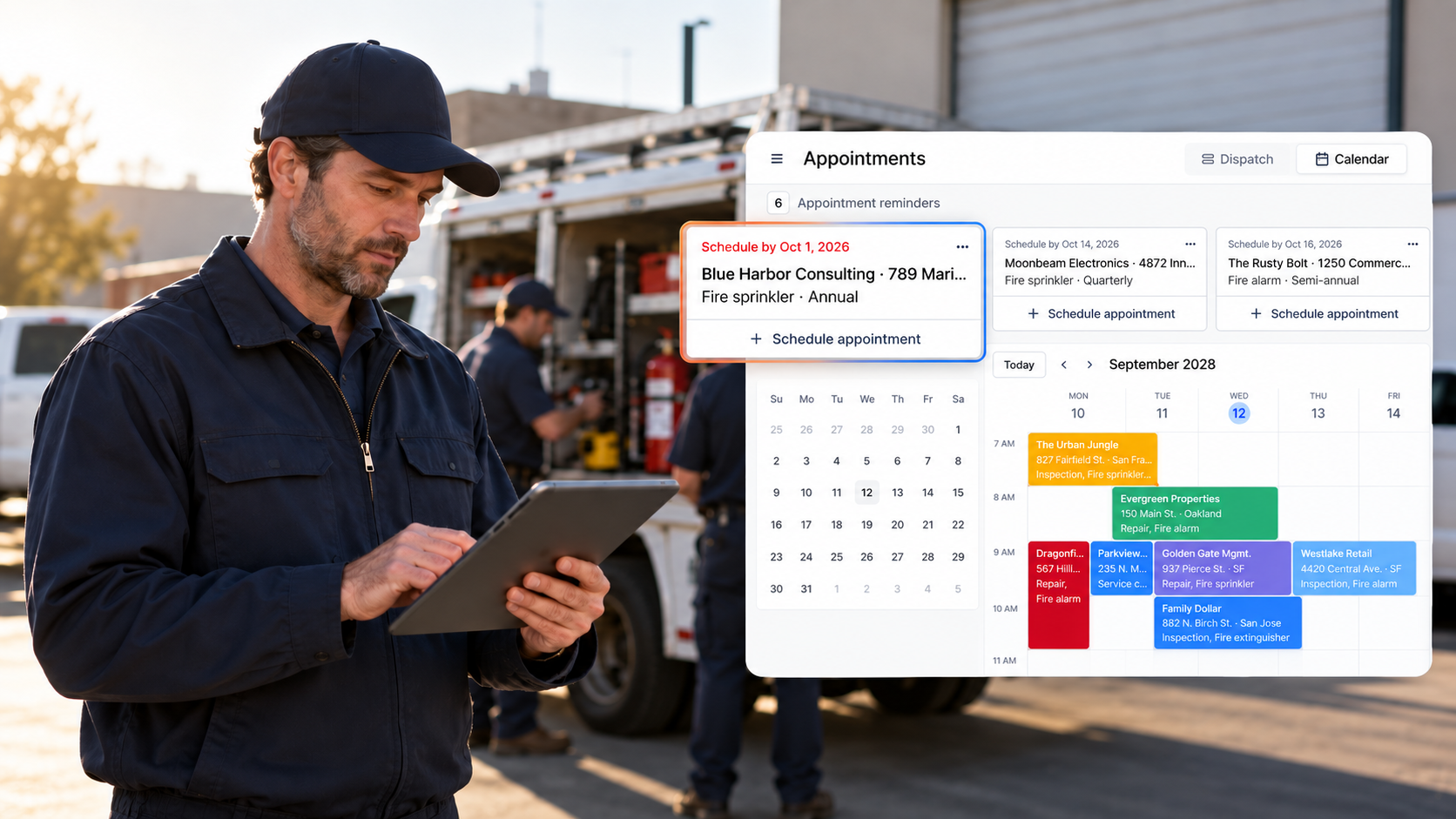
Tracking these tiers by hand across dozens of accounts, especially annual NFPA 25 fire pump testing and other multi-year cycles, is where fire protection companies lose time. To avoid this issue, look for fire inspection software that assigns the correct inspection interval to every account automatically. This kind of scheduling ensures overdue and upcoming inspections show up on their own instead of getting missed in a spreadsheet.
Who's Responsible for NFPA 25 Compliance?
The property owner or their designated representative holds ultimate responsibility for NFPA 25 compliance, even when a contractor performs the work and an AHJ enforces it.
Owners can delegate the actual work to a qualified contractor, but the obligation to keep it on schedule stays with ownership. Qualified personnel carry out the inspections themselves, with the required qualification level rising as tasks move from basic visual checks to full functional testing.
Simpler weekly and monthly checks can often be handled by trained building staff, while annual and multi-year testing typically calls for a licensed contractor. The AHJ enforces the adopted edition and follows up on deficiencies, but doesn't perform the work itself, and knowing your AHJ's other requirements matters just as much for staying compliant.
NFPA 25 Documentation and Recordkeeping Requirements
NFPA 25 doesn't leave recordkeeping vague. Every ITM record needs to document the procedure performed, who performed it, how often it occurs, the results and date, and the responsible party's name. NFPA 25's own floor is that records stay on file for at least a year past the next scheduled activity of the same type, but many AHJs and insurers expect records kept considerably longer than that minimum, so treat one year as a starting point rather than a target. Multi-year cycles, like the NFPA 25 5-year inspection, follow that same logic and typically call for records to stay on file even longer.
The property owner carries this obligation, and records need to be available to the AHJ on request. For a company managing many accounts, that means every inspection needs a clean, traceable record tied to the right system and property.
How NFPA 25 Classifies Deficiencies and Impairments
NFPA 25 sorts noncompliant findings into three categories, based on how urgently each one needs fixing.
- Noncritical deficiency: Doesn't materially affect a system's ability to function in a fire, but still needs correcting to meet the standard.
- Critical deficiency: Left uncorrected, can affect whether the system performs as intended when a fire happens.
- Impairment: Part or all of the system is out of order and may not function at all, which typically triggers notification procedures and sometimes a fire watch.
The 2026 edition adds timing guidance for closing each category out. Correcting critical deficiencies within 30 days and noncritical deficiencies within 90 days is now the recommended benchmark, with impairments expected to be addressed as soon as practical. While this recommendation is annex guidance rather than an enforceable requirement, AHJs are increasingly using it as the yardstick they measure a contractor's response time against.
Every deficiency found during an inspection is also a repair opportunity. Software that turns deficiency data directly into a fire inspection proposal can make the repair process more efficient, as it allows a quote to go out the same day instead of sitting in a stack of field notes waiting to get scoped
What Happens If You Don't Comply with NFPA 25
Noncompliance carries real consequences. Fire officials can issue violation notices, restrict occupancy, or force a building closed until systems are restored, and an impaired system often means a 24-hour fire watch at the owner's expense.
Insurance carriers increasingly expect proof of compliance, and a documented history of skipped inspections can complicate a claim after a loss. Even without a fire involved, a failed AHJ inspection alone can mean re-inspection fees and schedule delays, which is exactly why getting inspection reporting right the first time matters.
Frequently Asked Questions
Is NFPA 25 Law?
NFPA 25 isn't law on its own, but becomes legally enforceable once a jurisdiction adopts it by reference through a building or fire code.
Is NFPA 25 Mandatory?
It's effectively mandatory across most of the United States, since most jurisdictions adopt it into their local fire code even though the standard itself isn't law on its own.
What Is the Current NFPA 25 Edition?
The 2026 edition is the most recently published version, following the 2023 and 2020 editions.
Most jurisdictions adopt NFPA 25 into their fire code by reference, but don't have to adopt each new edition right away, so your AHJ may still be enforcing the NFPA 25 2020 or NFPA 25 2023 edition.
Staying Ahead of NFPA 25 Requirements With Ember
Staying compliant with NFPA 25 comes down to three things done consistently: keeping every account's required intervals straight, documenting each visit correctly, and closing out deficiencies before they turn into bigger problems. Ember’s fire protection software brings those three together.
Each account carries its own inspection schedule automatically, techs complete NFPA-compliant forms prefilled with prior visit data, and deficiencies flagged in the field convert directly into proposals the office can send the same day.
Learn more about how Ember's Job Information Hub keeps every account's inspection schedule, history, and compliance status in one place instead of split across spreadsheets and paper. Get a free demo to see how it fits your current inspection workflow.
News & Resources


Ready to simplify your fire inspection workflow?
Get a Free Demo